



Electric vehicles (EVs) are no longer a niche experiment or a futuristic promise. Across the globe, they are reaching a decisive turning point, moving steadily from early adoption into the mainstream. Governments, automakers, and consumers are converging around a shared realization: the future of transportation is electric, and the transition is now accelerating at an unprecedented pace.
One of the most significant drivers of this shift is policy support. Many countries have introduced ambitious targets to phase out internal combustion engine vehicles over the coming decades. Incentives such as tax rebates, purchase subsidies, reduced registration fees, and access to priority lanes have made EVs more attractive to buyers. At the same time, stricter emission standards and fuel economy regulations are pushing manufacturers to invest heavily in electric technology. These combined pressures are reshaping the automotive industry at its core.

Technological progress has also played a critical role in pushing EVs toward wider adoption. Battery technology, once the biggest obstacle, has improved dramatically. Modern EVs now offer longer driving ranges, faster charging times, and improved durability compared to earlier models. As battery costs decline, the price gap between electric vehicles and traditional gasoline cars continues to narrow. In some markets, EVs are approaching cost parity, especially when lifetime fuel and maintenance savings are considered.
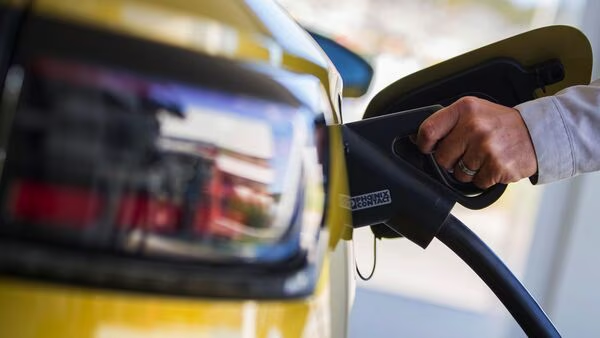
Charging infrastructure, long viewed as a barrier, is expanding rapidly. Public charging networks are growing along highways, in cities, and within residential complexes. Fast-charging stations now allow drivers to recharge significant battery capacity in minutes rather than hours. Meanwhile, home and workplace charging options are becoming more accessible, reducing range anxiety and making EV ownership more practical for everyday use. This growing infrastructure is essential in building consumer confidence and supporting mass adoption.
Consumer attitudes toward electric vehicles are also evolving. Early adopters were often motivated by environmental concerns or a passion for new technology. Today’s buyers are increasingly drawn by performance, convenience, and long-term savings. EVs offer smooth acceleration, quiet operation, and lower maintenance costs due to fewer moving parts. For many drivers, the experience of owning an electric vehicle simply feels better, reinforcing positive word-of-mouth and accelerating adoption through social influence.
Automakers are responding to this demand with unprecedented investment and innovation. Major manufacturers have announced timelines to electrify large portions of their fleets, while new entrants focused exclusively on electric vehicles continue to disrupt the market. From compact city cars to luxury sedans and electric trucks, the variety of EV models is expanding rapidly. This diversity ensures that electric mobility is no longer limited to a single demographic but accessible to a wide range of consumers.
Global adoption, however, is not uniform. Developed markets with strong infrastructure and policy support are leading the transition, while emerging economies face unique challenges. High upfront costs, limited charging networks, and inconsistent power supply can slow adoption in certain regions. Yet even in these markets, progress is visible. Governments are investing in charging infrastructure, local manufacturers are developing affordable electric models, and urban centers are prioritizing clean mobility solutions to address pollution and congestion.
Environmental considerations remain a central motivation behind the EV transition. Transportation is one of the largest contributors to greenhouse gas emissions worldwide, and electrification offers a clear path toward reduction, especially when paired with renewable energy sources. While concerns remain about battery production, raw material sourcing, and recycling, ongoing research and regulation are addressing these issues. Advances in battery recycling, alternative materials, and cleaner supply chains are improving the overall sustainability of electric vehicles.
The turning point in global EV adoption also reflects a broader shift in how societies think about mobility. Electric vehicles are increasingly integrated into smart city planning, shared transportation systems, and renewable energy grids. Vehicle-to-grid technology, for example, allows EVs to store and supply electricity, turning cars into mobile energy assets. This integration highlights how EVs are not just a replacement for traditional cars but a key component of future energy and transportation ecosystems.
Despite the momentum, challenges remain. Supply chain constraints, geopolitical tensions affecting critical minerals, and the need for workforce reskilling are ongoing concerns. However, the direction is clear. Investment, innovation, and consumer demand are aligned in ways that were not seen a decade ago. The automotive industry is undergoing its most profound transformation since its inception.
Electric vehicles reaching a turning point in global adoption signals more than a technological change—it marks a cultural and economic shift. As EVs become the norm rather than the exception, they are redefining how people move, how cities are designed, and how energy is consumed. The road ahead may still have obstacles, but the journey toward an electric future is no longer a question of “if.” It is firmly a matter of “how fast.”


